MANUSCRIPT 01 // arXiv:2608.09717Under review
How Do Large Language Models Judge Social Attraction? Evidence from Theory-Grounded Persona Ratings Across Multiple LLMs and Humans
Hasan Mahmud, Khawaja Abaid Ullah, Mohammad Javad Khojasteh, Jamison Heard, Prabu David
34 LLMs · 198 Humansevaluated across theory-grounded persona ratingsControlled analysis of human-LLM alignment and gender presentation
Evaluated social-judgment reliability and human-LLM alignment across 34 large language models and 198 human participants using theory-grounded persona ratings, including controlled analyses of gender presentation.
BibTeX Citation for How Do Large Language Models Judge Social Attraction? Evidence from Theory-Grounded Persona Ratings Across Multiple LLMs and Humans
@misc{mahmud2026socialattraction,
  title = {How Do Large Language Models Judge Social Attraction? Evidence from Theory-Grounded Persona Ratings Across Multiple LLMs and Humans},
  author = {Hasan Mahmud and Khawaja Abaid Ullah and Mohammad Javad Khojasteh and Jamison Heard and Prabu David},
  year = {2026},
  eprint = {2608.09717},
  archivePrefix = {arXiv},
  primaryClass = {cs.CL},
  url = {https://arxiv.org/abs/2608.09717}
}
MANUSCRIPT 02 // Manuscript under review (2026)Under review
Reversing the Incentive to Distill: A Review of Test-Time Antidistillation Defenses for Classification
Khawaja Abaid Ullah, Mohammad Javad Khojasteh
−34.5 pp / −47.7 ppbelow hard-label baseline on CIFAR-10 and CIFAR-100Unified matched-cost benchmark & method-agnostic top-1 wrapper
Built a unified matched-cost benchmark and a method-agnostic top-1-preservation wrapper; directed perturbations drove distilled students 34.5 pp (CIFAR-10) and 47.7 pp (CIFAR-100) below the hard-label baseline. Reimplemented prior test-time defenses under a common threat model and matched-cost evaluation protocol to isolate which perturbation mechanisms genuinely suppress student learning.
BibTeX Citation for Reversing the Incentive to Distill: A Review of Test-Time Antidistillation Defenses for Classification
@unpublished{ullah2026reversing,
  title = {Reversing the Incentive to Distill: A Review of Test-Time Antidistillation Defenses for Classification},
  author = {Khawaja Abaid Ullah and Mohammad Javad Khojasteh},
  year = {2026},
  note = {Under review}
}
MANUSCRIPT 03 // arXiv:2607.15467Under review · IEEE OJCS
ADS-C: Antidistillation Sampling for Classification
Khawaja Abaid Ullah, Mohammad Javad Khojasteh
−29.6 ppCIFAR-10 student accuracy (−17.4 pp CIFAR-100 · −13.3 pp Tiny-ImageNet)0 pp served top-1 accuracy cost
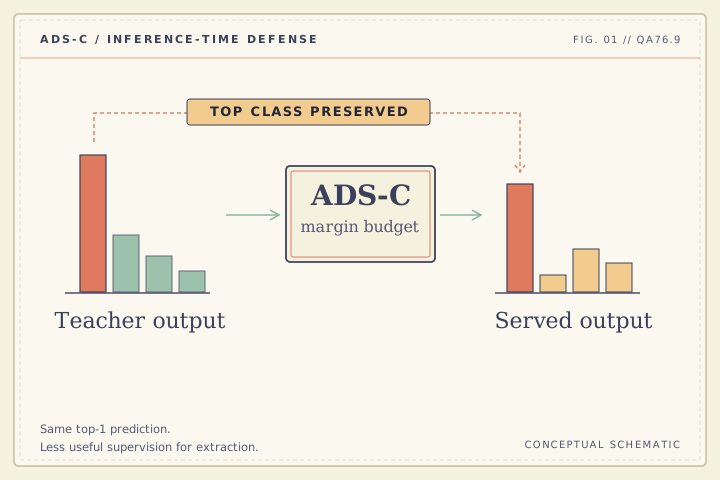
Proposed a margin-aware inference-time defense that preserves every served top-1 prediction while reducing distilled-student accuracy by 29.6 pp on CIFAR-10, 17.4 pp on CIFAR-100, and 13.3 pp on Tiny-ImageNet. Released with an open-source PyTorch evaluation harness across all three benchmarks and multiple student architectures.
BibTeX Citation for ADS-C: Antidistillation Sampling for Classification
@misc{ullah2026adsc,
  title = {ADS-C: Antidistillation Sampling for Classification},
  author = {Khawaja Abaid Ullah and Mohammad Javad Khojasteh},
  year = {2026},
  eprint = {2607.15467},
  archivePrefix = {arXiv},
  primaryClass = {cs.LG},
  url = {https://arxiv.org/abs/2607.15467}
}
DESK FOLIO // ADS-CPyTorch Harness · CIFAR-10 / 100 / Tiny-ImageNet
ADS-C — Antidistillation Sampling for Classification
Open-source PyTorch implementation and reproducible evaluation harness for ADS-C, preserving every served top-1 prediction while reducing distilled-student accuracy by 29.6 pp on CIFAR-10, 17.4 pp on CIFAR-100, and 13.3 pp on Tiny-ImageNet across multiple student architectures.
PyTorchML SecurityAntidistillationCIFAR-10 / CIFAR-100 / Tiny-ImageNet
DESK FOLIO // TERASJAX · PyTorch · TensorFlow (Keras 3)
Teras
Created a Keras 3-based tabular deep-learning library supporting JAX, PyTorch, and TensorFlow backends. Implemented state-of-the-art research architectures (SAINT, TabNet, TabTransformer, FT-Transformer, CTGAN, TVAE, GAIN, PCGAIN) for classification, regression, data imputation, and synthetic-data generation.
Keras 3JAXPyTorchTensorFlowTabular Deep Learning
DESK FOLIO // FONTUSPettingZoo Parallel · Ray RLlib · IPPO/PPO
Fontus — Multi-Agent RL for Aerial UAV Recharging
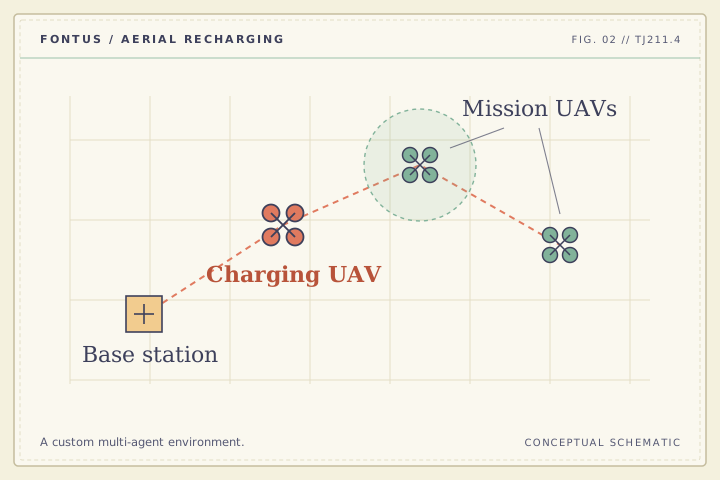
Built a custom PettingZoo Parallel multi-agent environment with vectorized NumPy dynamics, energy-aware transitions, and proximity-triggered charging; trained parameter-shared IPPO/PPO policies with PyTorch and Ray RLlib. Established an analytical no-charge baseline and diagnosed a reward-hacking ‘lazy agent’ local optimum.
PettingZoo ParallelPyTorchRay RLlibIPPO / PPOVectorized NumPy
DESK FOLIO // KERAS 3Official Keras 3 · Beta & Binomial Sampling
Keras 3 (Official Contributions)
Contributed Beta and Binomial random-sampling functionality (keras.random.beta, keras.random.binomial) and multi-backend consistency fixes to the official Keras 3 API across JAX, PyTorch, and TensorFlow.
Keras 3JAXPyTorchTensorFlowRandom Sampling APIs
DESK FOLIO // CODRIVERFlax Linen → NNX · Gemma 2 · 8× H100 GPUs
codriver (260M Distilled Code LLM)
Inspired by GitHub Copilot, built a custom 260M-parameter contextual code-generation model based on Google DeepMind’s Gemma LLMs. Ported Gemma 2 from Flax Linen to the NNX API and applied staged knowledge distillation—first using Gemma 2 2B on text (FineWebEdu) and then CodeGemma 2B on fill-in-the-middle code (CodeContests) across 8× H100 GPUs.
JAXFlax (Linen → NNX)Gemma 2 / CodeGemmaStaged Knowledge Distillation8× H100 GPUs
DESK FOLIO // MICROGRAD-CPure C · Reverse-Mode Scalar Autograd
micrograd_c
Implemented Andrej Karpathy’s micrograd from scratch in pure C: a scalar reverse-mode autograd engine and neural-network library exposing a PyTorch-like API.
CAutograd EngineNeural NetworksPyTorch-like API
ARCHIVE 01 // EARLY STUDY WORK2021 — 2023
Prewordict
A word-cloud guessing game built from clusters of words in Medium articles.
ARCHIVE 02 // EARLY STUDY WORK2021 — 2023
Gamer Assistant
A CS50 project combining game recommendations, PC suggestions, and FPS prediction.
ARCHIVE 03 // EARLY STUDY WORK2021 — 2023
PROLEAs
Undergraduate work on crowd detection and behavior analysis using computer vision.
ARCHIVE 04 // EARLY STUDY WORK2021 — 2023
FPS Predictor
An early machine-learning project estimating game performance from hardware data.
ARCHIVE 05 // EARLY STUDY WORK2021 — 2023
Tweets Cloud Bot
A Twitter bot that turned recent tweets into customizable word clouds.